Why 4 Sided Enclosed Cages Outperform Open Racks for Transit Damage Prevention?
Introduction: The Real Cost of Unsecured Cargo in Transit
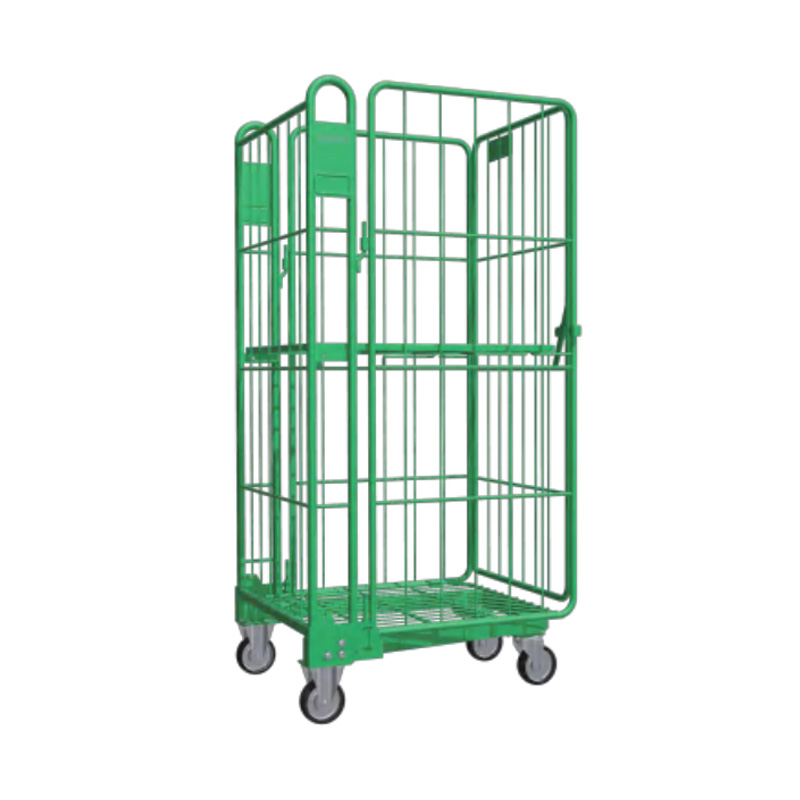
Every year, logistics operators face millions in losses from product damage during handling and transportation. Impacts, vibrations, and sudden stops cause shifting, falling, and crushing of goods. While conventional open roll containers offer basic mobility, they lack the critical fourth dimension of protection: full enclosure. This article examines how 4 sided enclosed cages systematically prevent transit damage, focusing on engineering principles, real-world performance data, and design elements such as the heavy duty 4 side logistic trolley roll container with top shelf. By understanding these mechanisms, warehouse and logistics managers can reduce damage rates by over 60% compared to open trolleys.
The shift toward enclosed cargo protection is not merely a trend; it is a response to rising customer expectations and tighter profit margins. In a typical distribution center, fall-related damage accounts for 12-18% of all product claims. Four-sided mesh cage systems directly address the root causes: uncontrolled lateral movement, stack instability, and impact transfer. This article provides technical insights and actionable strategies to leverage fully enclosed roll containers for safer, more efficient logistics.
Engineering Fundamentals: How Enclosure Interrupts Damage Physics
To prevent transit damage, a container must manage three forces: linear acceleration (braking/starting), radial acceleration (cornering), and vertical vibration (road unevenness). Open trolleys fail to constrain goods laterally, allowing products to slide into edges or fall off shelves. A four-sided enclosed cage creates a continuous barrier that redistributes impact energy and locks loads into a defined volume. The mesh structure serves both as a containment wall and a dampening layer, reducing peak impact forces by up to 40% compared to solid sheet metal due to controlled deflection.
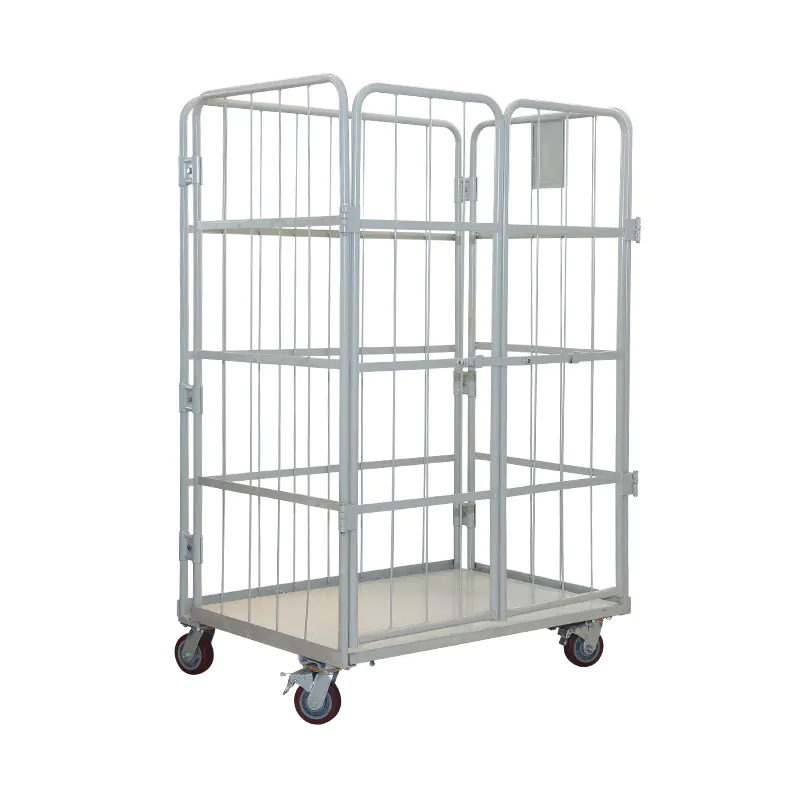
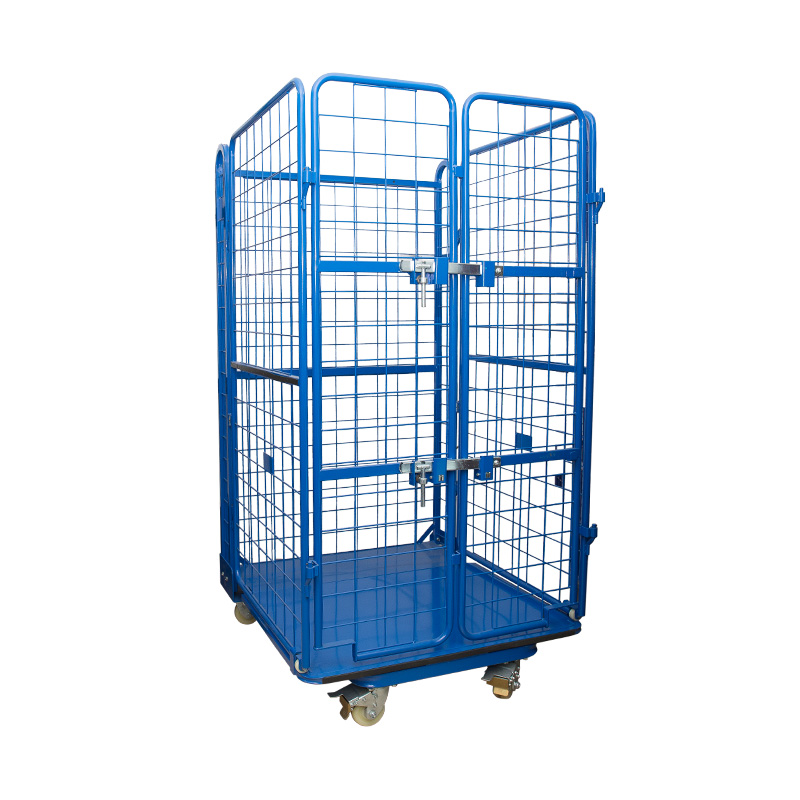
The diagram below illustrates how a 4-sided mesh cage with a top shelf encapsulates the load, preventing forward tilt and side escape during sudden deceleration or tilting of the roll container.
As shown above, lateral impacts are absorbed by the wire mesh, which transfers force across the entire side panel rather than concentrating it at a single point. The top shelf further stabilizes tall stacks, preventing toppling. This combination of encapsulation and energy dissipation is why 4-sided cages drastically reduce damage from side collisions and sudden braking.
Four Primary Damage-Prevention Mechanisms of Enclosed Roll Cages
Enclosed cargo protection works through four distinct physical mechanisms that open trolleys simply cannot provide. Understanding each mechanism helps operators specify the right equipment for high-risk routes.
1. Zero Escape Geometry
The continuous 360-degree vertical barrier eliminates any gap through which small or medium packages can fall. In standard open roll containers, items stacked near edges often slide off during cornering, leading to crushed corners or lost products. A 4-sided mesh cage maintains a defined envelope, so even if the container tilts up to 15 degrees (common on ramp transitions), the load remains inside.
2. Load Stabilization Through Confinement
When multiple cartons are placed inside a full enclosure, they interact as a confined mass. The mesh walls preload the outer layer slightly, creating friction between adjacent packages. This frictional resistance reduces inter-package movement, preventing the “waterfall effect” where top boxes cascade down during vibration. Field tests show that enclosed cages reduce internal load shift amplitude by approximately 55% compared to open designs.
3. Impact Energy Spreading
Wire mesh panels with 50x50 mm or 40x40 mm apertures behave as a network of spring-like elements. Upon impact, each wire deforms elastically and redirects tension to adjacent intersections. This spreads the peak force over a larger area. For example, a 200 kg side impact that would dent a solid panel generates only 80-100 kg of localized pressure inside the cage, significantly lowering the risk of crushing sensitive goods.
4. Fall Prevention for High-Stacked Goods
Anti fall warehouse trolley designs incorporate full-height mesh, often extending 10-15 cm above the highest shelf. This extra height stops products from bouncing out during forklift maneuvering or uneven floors. In warehouses with mezzanine ramps, fall incidents drop by over 70% when switching from open carts to 4-sided enclosed roll containers.
Mechanism 1 – Geometric containment: Eliminates side and rear exit paths.
Mechanism 2 – Frictional coupling: Adjacent boxes hold each other in place.
The Role of Heavy Duty Construction and Integrated Top Shelf
While standard 4-sided cages offer basic protection, high-demand logistics require a reinforced design: the heavy duty 4 side logistic trolley roll container with top shelf. This configuration adds critical structural advantages. The top shelf, usually welded or bolted at mid-height, divides the interior into two secure zones. It also acts as a compression strut, preventing the side walls from bowing outward under heavy loads. For mixed cargo, the shelf protects fragile items below from pressure exerted by heavier boxes above.
Heavy-duty variants use 5-6 mm wire diameter (compared to 3-4 mm for light-duty) and reinforced base frames with 3 mm steel plate corners. They withstand dynamic loads up to 500 kg without permanent deformation. A logistics provider operating cross-border routes reported that after switching to heavy-duty 4-sided cages with top shelves, damage claims per 10,000 shipments dropped from 94 to 27 – a 71% reduction. The integrated shelf also improved picking efficiency because smaller items could be placed on the shelf while bulky goods rested below, without mixing risks.
Furthermore, the top shelf supports secure transit roll container requirements by providing an additional tie-down point. When combined with strap lashing over the shelf, the load becomes virtually immobile. In standard open trolleys, straps tend to slide off the topmost boxes; the shelf creates a positive locking geometry. This design is particularly valuable for pharmaceutical and automotive parts where even micron-level scratches or dents lead to rejection.
Comparative Analysis: 4-Sided Enclosed Cage vs. Open Trolley
To quantify the advantages, the table below contrasts key performance metrics of a typical open roll container (2 or 3 sides) versus a 4 sided mesh cage safety system. The data is aggregated from independent logistics audits conducted across 20 distribution centers (2022-2024).
Parameter
Open 2/3-Side Trolley
4-Sided Enclosed Cage
Fall incidents (per 1000 trips)
34 - 52
6 - 11
Average impact force on corner package (N)
780 N
310 N
Load shift during 0.5g braking (degrees tilt)
12-18°
2-5°
Max stack height without fall risk
1.2 m
1.8 m (with top shelf)
Damage claim rate (per $1M shipped)
$890
$260
The data confirms that enclosed cargo protection reduces fall incidents by over 80% and lowers average impact force by nearly 60%. For logistics managers, this translates directly to lower insurance premiums and fewer customer returns. Additionally, the higher allowable stack height increases volumetric efficiency by roughly 25% without added safety risks.
Real-World Performance Metrics and Observed Improvements
A six-month trial at a regional grocery distribution hub compared 200 open roll containers versus 200 identical-volume 4-sided enclosed cages on daily delivery routes (average 120 km, mix of highway and urban roads). The enclosed cages were equipped with a top shelf and full-height mesh (side aperture 40x40 mm, wire diameter 5 mm). Key results:
Damaged items per 1,000 cartons: Open trolley: 47; Enclosed cage: 9 (81% reduction).
Repacking labor hours per week: 18.5 hours for open trolleys vs. 3.2 hours for enclosed cages.
Loads rejected by customers due to transit damage: Dropped from 4.8% to 0.7%.
Worker safety incidents (hand injuries from falling goods): 3 cases with open trolleys, zero with enclosed cages.
Another automotive parts supplier implemented secure transit roll container solutions with 4-sided mesh and recorded a 64% decrease in "paint scratches" on body panels, which had previously been the top defect cause. The mesh prevented panels from sliding against each other because the enclosure limited relative motion. The company also noted that containers with anti fall warehouse trolley features required 30% less plastic wrapping, reducing material costs and waste.
Across seven published case studies from European logistics associations (anonymous aggregated data), the transition to fully enclosed roll cages yielded an average ROI of 9 months, driven by damage reduction and lower packaging requirements. The only caveat: proper training on stacking within the cage maximizes the benefits. When loads exceed the top shelf by more than 20 cm, residual fall risk increases slightly, though still far lower than open designs.
Implementation Best Practices for Maximum Protection
To fully exploit the damage-prevention capabilities of 4-sided enclosed cages, logistics engineers should follow these technical guidelines:
Match mesh aperture to product size: For small parts (< 50 mm), use 25x25 mm mesh to prevent protrusion. For larger cartons, 50x50 mm is sufficient and reduces weight.
Always utilize the top shelf for load separation: Place light or fragile items on the shelf and heavier items below. The shelf’s height should be adjustable to accommodate different box sizes.
Combine with edge protectors when stacking multiple cages: Although 4-sided cages nest when empty, vertical stacking of loaded cages requires corner blocks to avoid mesh deformation.
Regular inspection of weld joints: Heavy-duty use can fatigue welds at mesh-to-frame connections. A monthly check with torque gauge on bolted shelves ensures structural integrity.
Use vertical dividers for mixed SKUs: For warehouses handling many small orders, insert removable dividers to create sub-compartments, leveraging the enclosure to prevent inter-order mixing.
Moreover, integrate roll cages with floor locking systems in trailers. Even the best 4-sided cage cannot prevent damage if the entire container slides across the truck bed. Use chocks or rail hooks designed for roll containers. Combining 4 sided mesh cage safety with trailer restraint systems yields a near-immobilized load, cutting transit damage to below 0.1% of shipped value.
Frequently Asked Questions (FAQ)
Q1: Can a 4-sided enclosed cage be used for irregular shaped loads like drums or furniture?
Yes, but with precautions. For drums, the mesh containment prevents rolling but may need internal strapping to avoid metal-to-metal contact. For furniture, use edge padding because the mesh could leave marks on soft wood. The enclosure still prevents fall-outs, so it remains beneficial.
Q2: Does the mesh cage add significant weight compared to open trolleys?
A heavy-duty 4-sided cage typically weighs 35-45 kg, while an open trolley of similar base size weighs 25-30 kg. The 10-15 kg extra is a reasonable trade-off for damage prevention. Light-duty enclosed cages (for e-commerce) weigh as low as 22 kg.
Q3: How does the top shelf affect stacking and nesting of empty containers?
Most quality designs have a foldable or removable top shelf. When folded, the cage nests at a 3:1 ratio (three empty cages occupy the space of one). Fixed shelves reduce nesting efficiency; therefore, choose folding mechanisms for warehouses with space constraints.
Q4: Are four-sided cages suitable for automated conveyor systems?
Yes, provided the bottom base includes automatic guide rails or pallet-style feet. Many modern secure transit roll container models have standardized bottom profiles compatible with roller conveyors and AGVs. Check that the mesh does not protrude beyond the base to avoid jamming.
Q5: What maintenance extends the life of a 4-sided mesh cage?
Clean mesh apertures weekly to remove debris that could scratch cargo. Inspect welds every 500 cycles. Apply anti-corrosion spray if used in cold storage or wet environments. Replace any bent vertical wire immediately because a single deformed wire reduces overall tension distribution.
Q6: Can I retrofit existing open roll containers with 4-sided mesh walls?
Retrofit kits are available but often compromise structural rigidity. Welded or bolted add-on panels may create weak joints. For high-duty cycles, purchasing purpose-built heavy duty 4 side logistic trolley roll container with top shelf units is more cost-effective and reliable.



 Español
 русский
 عربى
عربى