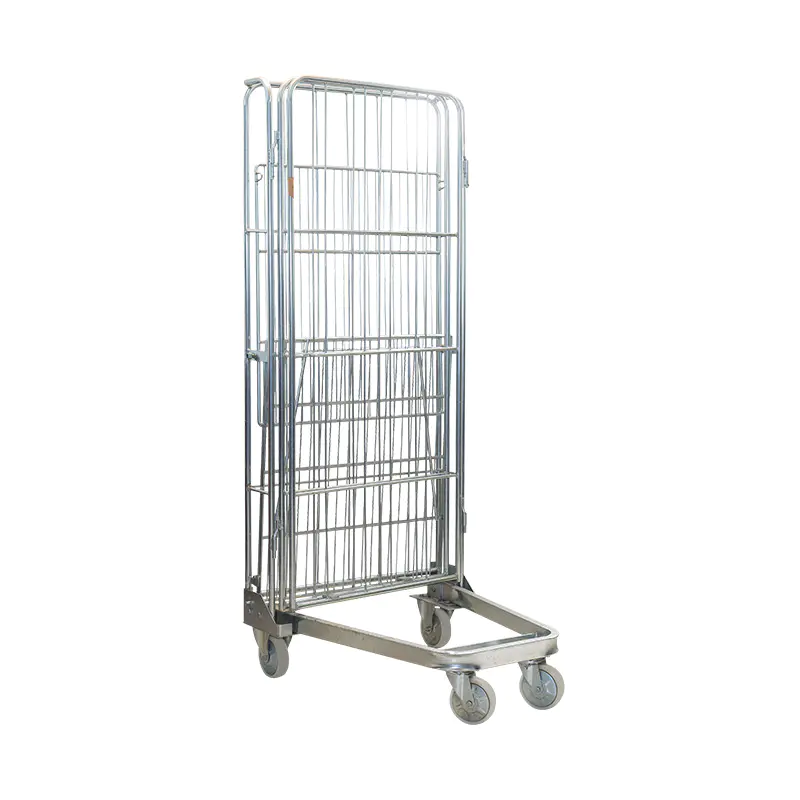
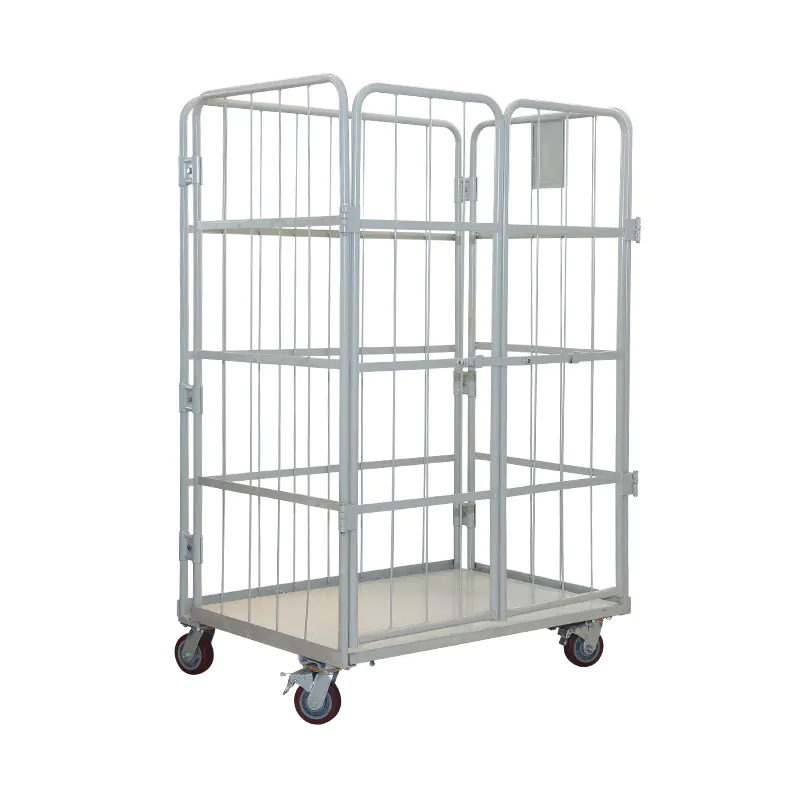
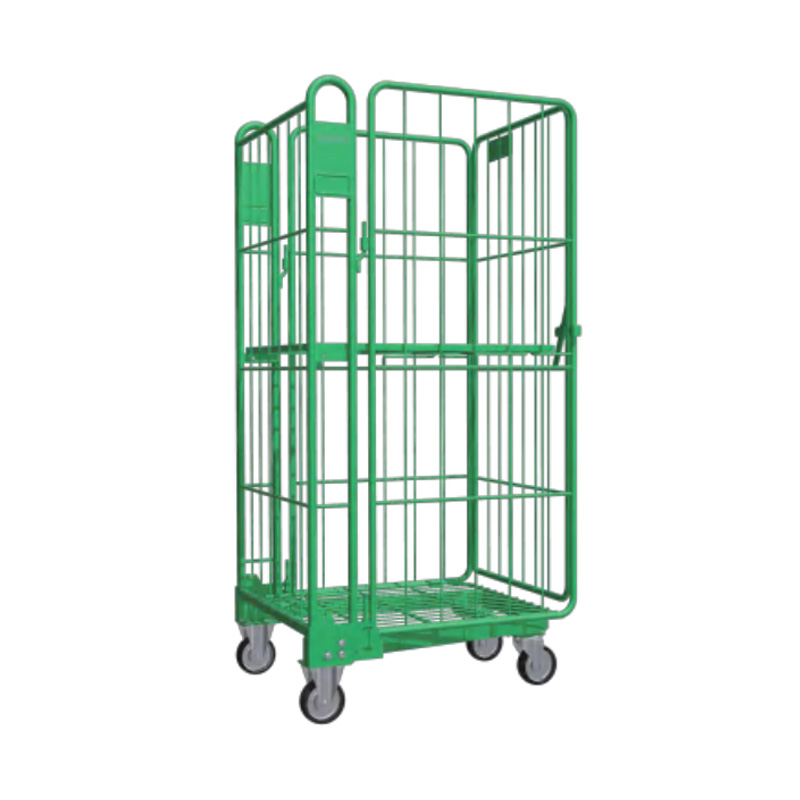
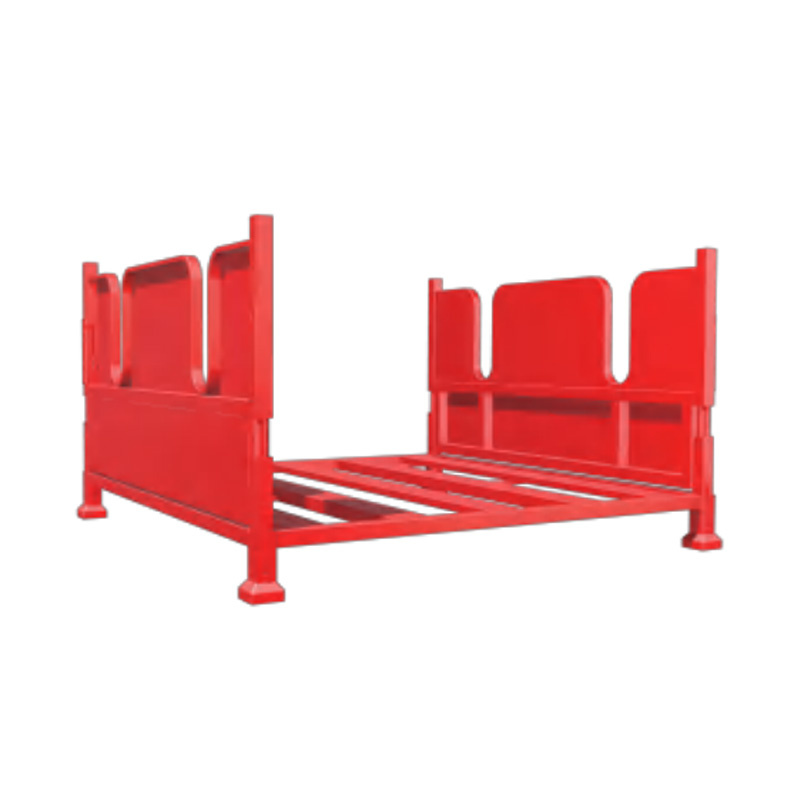
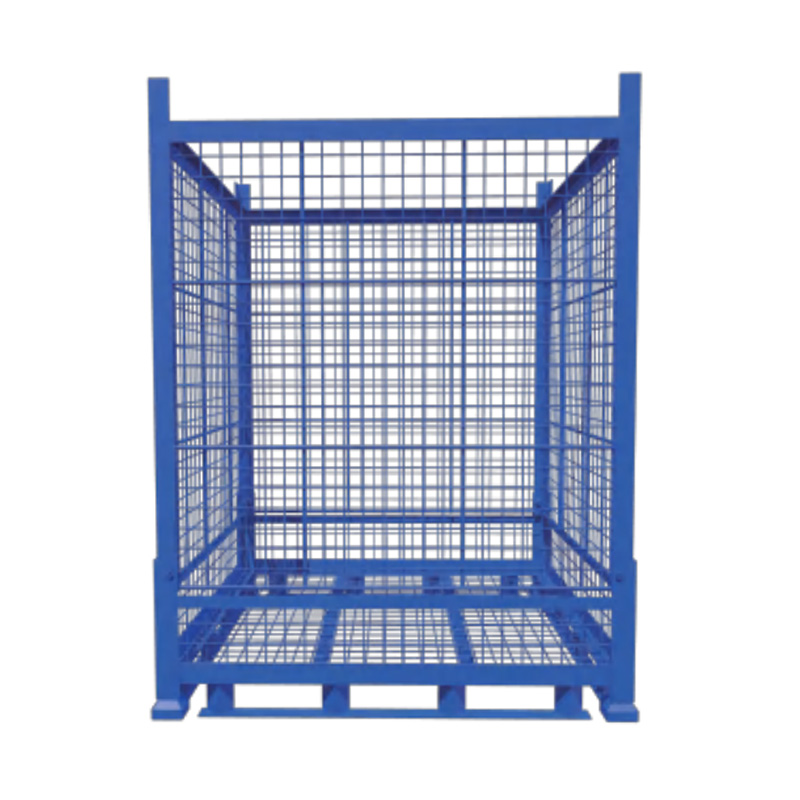
A 3 sided heavy duty roll container with net is an essential tool in modern warehousing, logistics, and retail operations. Designed for durability, mobility, and efficient storage, this type of roll container supports heavy loads while providing easy access to goods. Central to its strength and reliability is the method by which its frame is assembled. Welding and joint techniques play a crucial role in determining the container’s load-bearing capacity, longevity, and safety.
Overview of a 3 sided heavy duty roll container with net
A 3 sided heavy duty roll container with net typically consists of a robust steel or aluminum frame, four wheels for mobility, and a mesh net on three sides to secure the load. The open side allows for easy loading and unloading, while the other three sides provide containment and structural support. These containers are widely used in warehouses, supermarkets, distribution centers, and manufacturing facilities.
The design of the container must balance strength, mobility, and ease of use. Welding and joint techniques are critical in ensuring that the frame can withstand heavy loads, resist deformation, and maintain stability under repeated use. Weak or poorly executed joints can lead to frame failure, operational hazards, and increased maintenance costs.
Importance of welding in roll container construction
Welding is the primary method for joining metal components in a 3 sided heavy duty roll container with net. Unlike mechanical fasteners, welding creates a permanent bond between the steel or aluminum parts, ensuring structural integrity under heavy loads. Proper welding provides uniform strength across the frame, eliminates movement at connection points, and reduces the risk of metal fatigue.
The selection of a welding technique depends on several factors:
- Material type: Steel and aluminum require different welding approaches.
- Load requirements: Heavy-duty containers need high-strength joints.
- Environmental conditions: Warehouses with moisture or chemical exposure may require corrosion-resistant welds.
- Production efficiency: Automated or semi-automated welding can reduce labor costs while ensuring consistent quality.
Common welding techniques for a 3 sided heavy duty roll container with net
Several welding techniques are commonly used in the construction of a 3 sided heavy duty roll container with net. Each method has specific advantages depending on the container design, load requirements, and material.
1. MIG welding (Metal Inert Gas)
MIG welding is widely used in the fabrication of 3 sided heavy duty roll container with net frames. It involves feeding a continuous wire electrode into the weld joint while shielding the weld area with an inert gas, typically argon or a mix of argon and CO₂.
Advantages for roll containers:
- Provides a clean, strong weld suitable for steel frames.
- Efficient for high-volume production.
- Allows for consistent weld quality, which is essential for heavy-duty applications.
- Can join a range of steel thicknesses commonly used in roll container frames.
MIG welding is particularly suitable for straight joints and corner connections, which are common in the frame of a 3 sided heavy duty roll container with net.
2. TIG welding (Tungsten Inert Gas)
TIG welding is another common technique, especially for aluminum or stainless steel roll container frames. It uses a non-consumable tungsten electrode to produce the weld while shielding the weld pool with inert gas.
Advantages for roll containers:
- Produces high-precision welds with excellent appearance.
- Suitable for thinner metals where heat control is critical.
- Reduces the risk of warping or deformation.
- Ensures strong, clean joints that maintain the structural integrity of the container.
TIG welding is often applied to load-bearing joints and frame intersections, where precision and strength are critical.
3. Spot welding
Spot welding is a resistance welding technique in which electrical current is applied to metal sheets at localized points, fusing them together. This technique is widely used for attaching mesh nets to the frame of a 3 sided heavy duty roll container with net.
Advantages for roll containers:
- Fast and efficient for repetitive production tasks.
- Creates strong bonds at multiple points without extensive heat application.
- Ideal for joining thin sheet metal components, such as mesh panels.
- Reduces distortion compared to continuous seam welding.
Spot welding is particularly valuable for securing the net to the frame while maintaining a neat, professional finish.
4. Arc welding
Manual arc welding, or shielded metal arc welding (SMAW), is occasionally used for heavier components of a 3 sided heavy duty roll container with net, especially when thick steel tubing forms the frame.
Advantages for roll containers:
- Can join thick metals that may be difficult to weld with MIG or TIG.
- Provides deep penetration welds for maximum joint strength.
- Does not require complex equipment, suitable for smaller-scale or custom fabrication.
Arc welding is ideal for corner joints and base plate connections, which are critical in maintaining the container’s stability under heavy loads.
Joint design techniques in roll container construction
While welding techniques are essential, the overall joint design significantly impacts the performance of a 3 sided heavy duty roll container with net. The combination of proper welding and intelligent joint design ensures durability, load distribution, and resistance to mechanical stress.
1. Butt joints
Butt joints are created when two metal pieces are aligned edge to edge and welded along the seam. This type of joint is common in the horizontal and vertical frame members of a 3 sided heavy duty roll container with net.
Benefits:
- Provides strong linear connections.
- Minimizes material overlap, reducing weight.
- Allows for smooth frame surfaces and easy attachment of mesh nets.
2. Lap joints
Lap joints involve overlapping two metal pieces and welding along the edge. This design is commonly used at intersections where vertical and horizontal frame elements meet.
Benefits:
- Distributes load across a larger area.
- Provides additional strength at high-stress points.
- Compatible with MIG and TIG welding techniques.
3. Corner joints
Corner joints are critical in maintaining the square and rectangular structure of a 3 sided heavy duty roll container with net. Welds at corners must be precise to prevent misalignment and instability.
Benefits:
- Ensures structural rigidity under heavy loads.
- Prevents frame twisting or bending.
- Supports proper attachment of caster wheels and base plates.
4. Fillet welds
Fillet welds are triangular welds applied at the intersection of two surfaces. They are commonly used for attaching mesh nets, corner braces, and reinforcement plates on a 3 sided heavy duty roll container with net.
Benefits:
- Provides strong, durable connections for frame reinforcement.
- Simple to execute with MIG or TIG welding.
- Effective for joining components at different angles.
Considerations for ensuring quality welds
Ensuring high-quality welds in a 3 sided heavy duty roll container with net is essential for safety, durability, and performance. Key considerations include:
- Material preparation: Surfaces must be clean and free of rust, oil, or paint.
- Weld penetration: Adequate penetration ensures that the weld fuses the metals fully, avoiding weak joints.
- Heat control: Excessive heat can distort the frame, while insufficient heat may produce weak welds.
- Inspection: Visual inspection, dye penetrant tests, or ultrasonic tests can identify defects.
- Corrosion protection: Post-weld treatment such as galvanization or powder coating enhances durability.
Integration of welding and net attachment
The net component of a 3 sided heavy duty roll container with net is typically attached after the frame has been fully welded. Techniques such as spot welding, riveting, or clip fastening may be used to secure the net while maintaining flexibility and accessibility. Proper integration ensures that:
- Loads remain secure during movement.
- The net can be replaced or repaired without affecting the main frame.
- The container maintains stability even with unevenly distributed cargo.
Practical implications for buyers and warehouse operators
Understanding the welding and joint techniques used in a 3 sided heavy duty roll container with net is essential for buyers and warehouse managers. Properly welded containers:
- Offer long service life, reducing replacement costs.
- Maintain high load-bearing capacity without deformation.
- Provide a safe working environment by preventing joint failures.
- Support efficient logistics operations with smooth mobility and reliable containment.
For industrial buyers, questions about welding techniques often intersect with concerns about load safety, maintenance requirements, and compliance with workplace regulations. Ensuring that suppliers use proven methods like MIG, TIG, spot welding, and appropriate joint designs is a critical part of procurement decisions.



 Español
 русский
 عربى
عربى